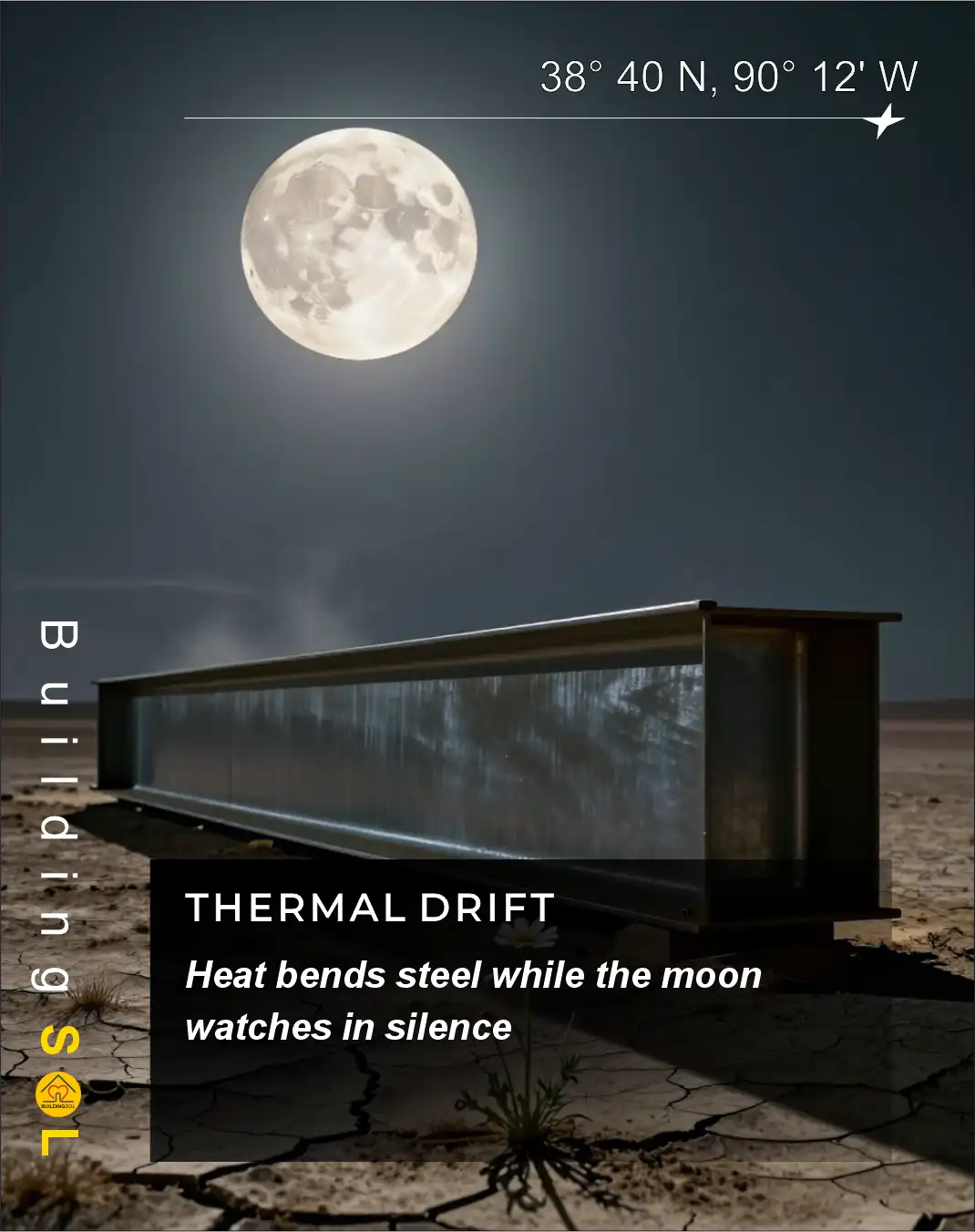
"Heat bends steel while the moon watches in silence."
💡 Reflection
Modern facility management is facing a costly, invisible challenge: the combination of high summer temperatures and rising groundwater levels is putting severe physical stress on building foundations and cooling systems.
When ambient temperatures hover near 90°F alongside high soil moisture, it creates a dual-stress event. The building's foundation faces pressure from the wet ground below, while the air conditioning systems must work twice as hard to combat the humid air above. Failing to address these stressors early results in an estimated 8% annual increase in operational risk and faster equipment breakdown, heavily impacting the bottom line.
The Bottom Line: The building is sweating from the heat, and the mechanical systems are becoming too expensive to run. We must optimize our insulation and seal foundation vulnerabilities before emergency repair costs drain the capital budget.
🌦️ Current Infrastructure Weather Stressors
Thermal Expansion (Hot Corridor): Summer heat indexes near 90°F cause standard materials like concrete to expand, putting stress on structural joints.
Humidity & Latent Load (Mixed Belt): High humidity forces air conditioning systems to run longer to remove moisture from the air, increasing energy bills and the risk of mold.
Groundwater Pressure (Cold Tier): Elevated river stages saturate the surrounding soil, creating pressure that pushes against lower-level concrete slabs and foundation walls.
🏛️ Historical Anchors & Context
Physical Case Study (The Bissell Street Water Tower): Located at 38° 40' N, 90° 12' W, this historic 1870s structural landmark provides an elegant lesson in material endurance. Modeled as a massive Corinthian column, its hidden structural core has stood against over a century of continuous Mississippi River moisture and extreme Midwestern thermal cycling, proving that hidden structural vulnerabilities require vigilance long before they are visible to the naked eye.
The Solution (Building Information Modeling): We use digital twin technology to pair live sensor data with digital models. This allows us to predict structural stress and mechanical wear before a costly failure happens.
The Physics of Materials: In construction history, managing how materials react to weather is a primary focus. Today, engineers use precise calculations to ensure steel and concrete can expand and contract safely without cracking or warping.
📢 DM me directly. I am actively consulting with forward-thinking infrastructure owners, higher education asset managers, and enterprise operations teams to bridge the exact operational gaps simulated in these daily briefs. Let's discuss standardizing your data translation layers.
Visual Description: A large, polished steel I-beam rests horizontally across a dry, deeply cracked desert landscape at night under a brilliant full moon. The moon shines brightly in a dark, clear sky, casting a long, crisp shadow from the beam onto the parched ground. In the foreground, breaking the desolate scene, a single delicate white daisy with a yellow center grows directly out of a fissure in the earth, positioned right beside the massive metal structure.